
 Login
Login
 Create an account

Zcash Mining Became 4 Times More Profitable Than Bitcoin
13 Sep 2026
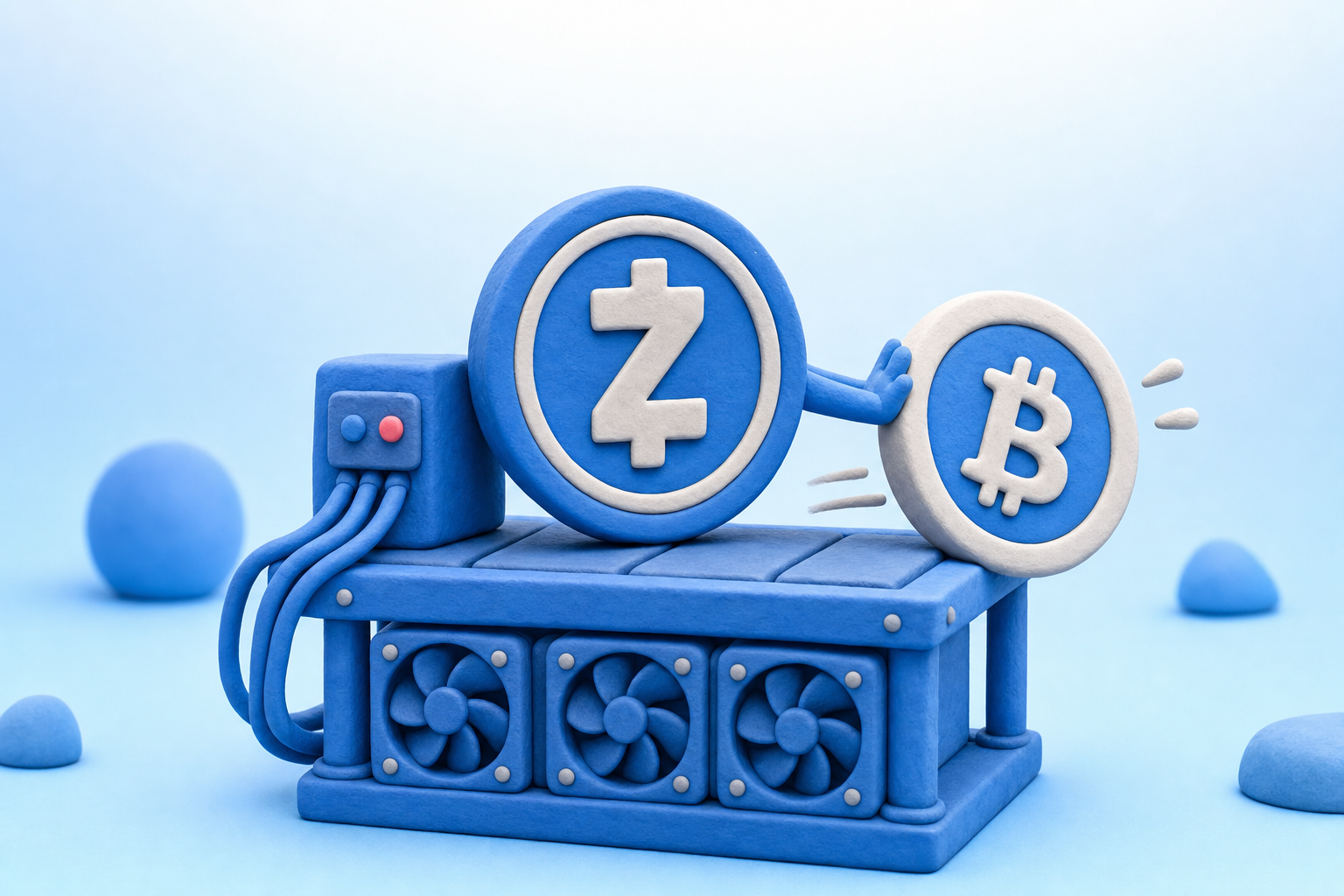
Zcash mining has become 4 times more profitable than Bitcoin amid the rise in ZEC. This pushed the network’s hashrate up by more than 2.5 times since the start of the year.
This was reported by Grayscale’s head of research, Zachary Pendle. In his view, Zcash miners’ reward is roughly twice as high per mining device, and when calculated per megawatt-hour, the difference already reaches fourfold.
The numbers here are simple. In Bitcoin, the total daily miner reward is about $35 million. In Zcash, this figure is about $2 million. But a smaller amount does not mean less interest. On the contrary, because of the efficiency gap, miners are increasingly looking at ZEC itself.
Why did Zcash suddenly become so attractive?
The reason is almost entirely price. In September, ZEC broke above $1000, and its market cap rose above $17 billion. At the time of writing, the coin is priced at $1,138, and its market value exceeds $19 billion.
This is no longer a minor move. According to CoinGecko, on September 12 ZEC closed at $1 121,73, and daily trading volume reached $1,786 billion. On September 13, the coin is trading around $1 102,58. For comparison, Bitcoin at that moment costs $77 280, meaning 1 ZEC equals approximately 0,01427 BTC.
There is another important point. Zcash runs on Proof-of-Work, just like Bitcoin. That means miners compete for blocks through computation. When the coin’s price rises faster than electricity and hardware costs, mining becomes more attractive. That is exactly what we are seeing now.
What does the hashrate growth mean for the network?
When more power enters the network, it becomes more resistant to attacks. That is the basic PoW mechanism. Pendle says directly that Zcash’s higher profitability is increasing mining activity and strengthening network security.
But there is also a downside. According to z.cash, after the 2024 halving, Zcash’s block subsidy is 1,5625 ZEC, and 80% of that reward goes to miners. That is about 1 152 blocks per day and roughly 1 440 ZEC per day for miners. At the current price, that is approximately $1,59 million per day excluding fees. In other words, the market already sees that the network is sustained by more than speculation alone.
“Due to the strong price momentum of the token, Zcash mining has become highly profitable,” said Zachary Pendle of Grayscale.
That is why new money is flowing not only into ZEC itself, but also into hardware. And that is changing the balance of power among miners.
Market reaction
Zcash’s rise did not happen in a vacuum. The market has long liked stories where privacy, scarcity, and PoW come together in one coin. But this time, a new instrument also appeared, giving institutions a more convenient entry point.
On August 25, 2026, trading in The Zcash ETF (ZCSH) from Grayscale Investments began on NYSE Arca. This matters because after an ETF launch, attention to an asset usually grows faster than after a regular news item. Later, on September 8, the fund already had $532,95 million AUM and 464 514,8551 ZEC in its portfolio. Such figures explain why interest in the coin is not fading.
There is also an operational signal from the network. According to ZecStats, as of September 13, 2026, Zcash had 5 567 transactions in 24 hours, hashrate reached 27,4 GSol/s, and there were 978 available nodes. This is not just noise around the price. It is already a live network with noticeable activity.
Mining Zcash is now 4 times more profitable than Bitcoin per MWh.
Bitcoin’s daily miner reward is about $35 million.
Zcash’s daily miner reward is about $2 million.
Zcash mining activity has increased by more than 2.5 times since the start of the year.
On September 13, ZEC is trading around $1 102,58.
The coin’s market cap exceeds $18,99 billion.
What does this mean for investors?
For ZEC holders, this is a signal that the coin has moved beyond a narrow niche. When miners see profit, they add power. When hashrate grows, the network becomes stronger. And when an ETF appears, new buyers enter the game.
But the short term matters here too. On September 13, ZEC had already fallen 3,36% over the day to $1 102,58, with an intraday range of $1 076,46–$1 154,80. In other words, the market does not move upward without pauses. For those looking at ZEC as an investment, this means one simple thing: the move is strong, but volatile.
Another nuance for Ukrainian users. If the coin continues to hold above $1000, interest in exchanging it may remain high among those who want to lock in profits in hryvnia. In such a situation, it is convenient to have sell USDT TRC20 for hryvnia to a card at hand.
Frequently asked questions
Why has Zcash mining become more profitable than Bitcoin mining?
Because of the sharp rise in ZEC’s price. According to Grayscale, profitability per device in Zcash is roughly twice as high, and per megawatt-hour, about 4 times higher than in Bitcoin.
Does this mean Zcash is more secure?
Higher profitability really does push miners to add hashrate. And that usually strengthens network protection. But security depends not only on price, but also on how power is distributed among pools.
Which figures are most important for ZEC right now?
The most notable ones right now are: $1 102,58 per coin, a market cap above $18,99 billion, 5 567 transactions in 24 hours, and 27,4 GSol/s of hashrate. These show that interest in Zcash has already moved beyond a short-term pump.
Zcash now looks like a rare case where price, mining, and institutional demand are moving in the same direction. If this trend continues, the coin will more than once find itself in the spotlight. And for those tracking the rate and wanting to lock in results quickly, a fast exchange method will come in handy.
This material is not financial advice. Cryptocurrency trading involves significant risks. Part of this text was prepared with the help of artificial intelligence based on public sources and reviewed by our editorial team.